
Rogers Directory Shelf Guide
No source proves an unbroken Rogers run. The record is instead a set of separate city directory and regional telephone titles, each held by a different institution. That distinction matters. A gap in any list can mean three things. No volume was published, none has been cataloged online, or a local shelf list still needs a staff check. Among the holders, the Rogers Historical Museum collections keep local directories, maps, oral histories, research reports, and newspaper files. The museum publishes no year-by-year directory list, though.
| Directory or collection | Known year or span | Repository | How to use it |
|---|---|---|---|
| Rogers city directory | 1939 | St. Louis County Library catalog; ask Rogers museum | Microfilm catalog evidence |
| Tri-Cities Bentonville, Rogers, Springdale directory | 1947 | St. Louis County Library catalog | Microfilm |
| Northwest Arkansas Polk Cross-Reference Directory | 1996 | Shiloh Museum of Ozark History | Address-to-name reference |
| Rogers, Bentonville, Bella Vista telephone directory | 1998 | Shiloh Museum | Cataloged telephone book |
| Regional directories | 2000, 2001, 2004-05, 2008, 2009 | Shiloh Museum | In-person cataloged volumes |
| Local directories, dates not posted | Unspecified | Rogers Historical Museum | Appointment and shelf request |
The early reels exist. The Arkansas city-directory catalog confirms the early microfilms and pairs each title with its place, so the two must be checked together before any reel is trusted.
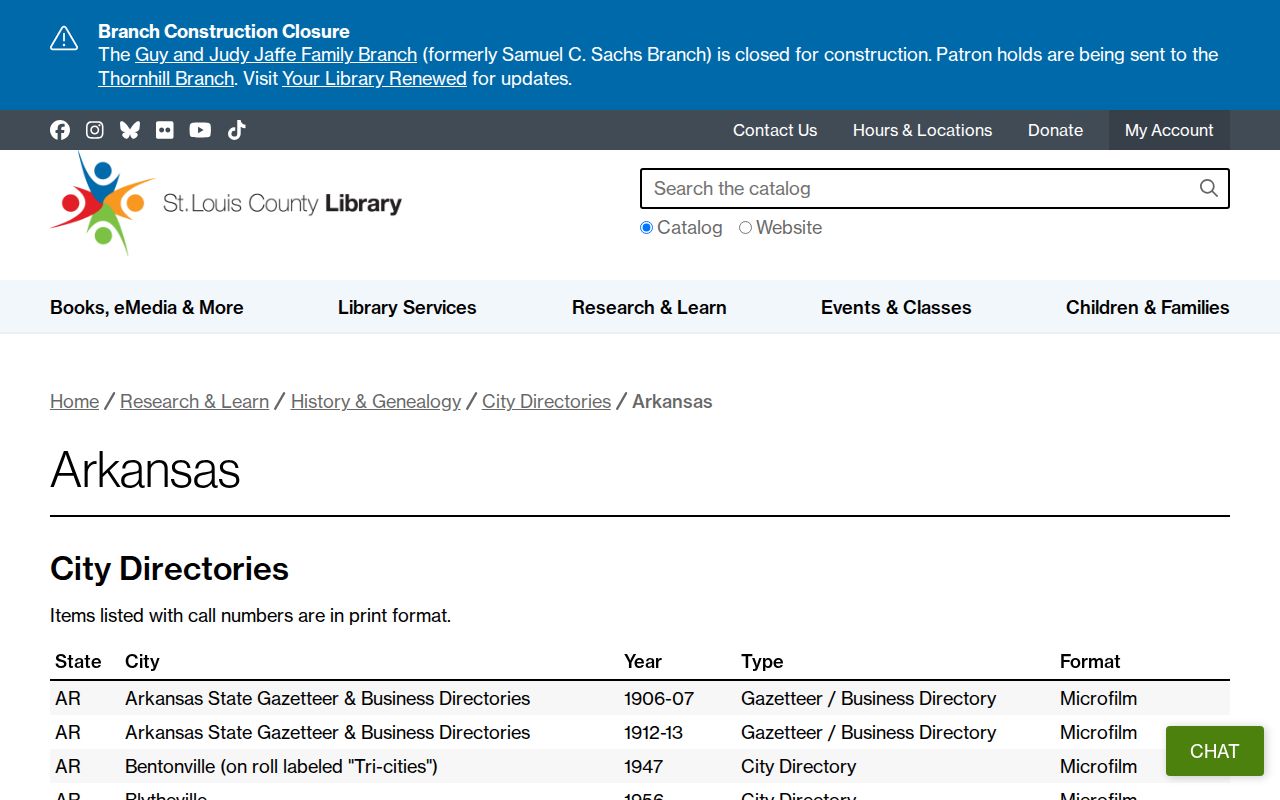
That catalog view rewards a known-item search. It does not prove that Rogers published a volume every year, nor that every listed reel is available online.
Rogers Museum Directory Research
The Rogers Historical Museum is the strongest city-specific stop for directory work. Its research library takes visitors by appointment only. Call 479-621-1154 before going. An older museum guide describes about 4,000 library items, early local-newspaper microfilm, cemetery and obituary files, and an index to roughly 25,000 copied historic photographs. Current files reach wide. They cover people, houses, roads, schools, churches, firms, railroads, hotels, doctors, orphan trains, and public offices. A subject file can explain a terse directory line. It cannot turn an unproved association into fact. A good request names the person, the likely years, address variants, a spouse, and any known business. Ask staff first for the local directory shelf list, the title page, and the abbreviation key. Then ask for the surname. That order gives the search a sound frame. The museum now reports more than 65,000 objects, most dating from 1819 forward, yet only a small share is directory material. Its online Rogers exhibits add useful context on mail, health care, poultry, Beaver Lake, and Apple Blossom festivals.
Appointment tip. Ask whether a chosen volume is alphabetical, reverse by street, or both before planning how to copy its entries.
Note: An older guide's access and copy details may be stale, so follow the museum's current appointment rule for any Rogers research visit.
Known Rogers Directory Years
The known years have large, honest gaps. The Encyclopedia of Arkansas history of Rogers traces the town to a Frisco Railway stop in 1881, long before the first verified stand-alone directory item appears in the available catalogs. The city's own brief Rogers history offers another dated local chronology. Titles widened later. Regional publishing stretched the coverage area well beyond Rogers. A Rogers household may sit inside a Northwest Arkansas title rather than a book labeled only with the city.
| Year | Directory milestone |
|---|---|
| 1939 | Verified Rogers directory microfilm |
| 1947 | Verified Tri-Cities Bentonville, Rogers, Springdale directory |
| 1996 | Verified R.L. Polk Northwest Arkansas cross-reference volume |
| 1998 | Verified Rogers, Bentonville, Bella Vista telephone directory |
| 2000-09 | Several verified regional directory titles, not a continuous annual run |
The later titles trace to the Shiloh Museum catalog. FamilySearch also holds a broad United States city and business directory collection. No open catalog confirms a specific Rogers year there. Its umbrella dates show collection scope, not local coverage. A museum staff check is still the best route. It can reach uncataloged or newly processed Rogers books.
Read Rogers Directory Entries
No open scan shows an actual Rogers entry. Record what the chosen book truly prints. Generic directory habits can guide the inventory. They cannot be presented as marks verified in every Rogers volume. Before copying a name, photograph the title page, publication year, place coverage, and abbreviation key.
| Name | Copy surname, given name, middle initial, suffix, and name variants exactly. |
|---|---|
| Family clue | Record a spouse in parentheses or widow notation only if the volume uses it. |
| Work clue | Transcribe occupation and named firm, then compare that firm with the correct Rogers era. |
| Place clue | Keep the full house number, street label, telephone, and any rooms or residence mark. |
| Index clue | Note whether the book has a street-order section or owner and renter symbols. |
- Criss-cross directory
- A book arranged by street and house number, making an address the starting point rather than a surname.
- Householder index
- A section that ties a listed home or address to the person named as householder.
- Abbreviation key
- The publisher's own list explaining short forms and symbols. It controls how that volume should be read.
- Entry image
- A copy of the printed line. It should stay linked to the title, year, and page citation.
A printed address is limited. It shows what the publisher listed at the time, and nothing more. Children, boarders, unlisted adults, and short-term occupants may all be absent from the entry.
Rogers Cross-Reference Directory Era
The 1996 R.L. Polk volume changed the method. A cross-reference book lists streets in name order. Houses run in number order. That layout can turn an old Rogers address into a named householder, a business, or a telephone clue, and the later regional titles show how far Northwest Arkansas had grown beyond a single-city market. Start with the street spelling printed in the volume. Check nearby house numbers too. An omitted number may be a publication gap, not proof that the building stood empty. If the book has an alphabetical section, move from the listed name to that part next. Modern parcel searches belong in the Rogers Street Directory. The historical book should not answer current occupancy. Note: The verified 1996 volume supports reverse searching for that year, and later regional titles may not share its arrangement.
Pair Rogers Directories With Census
Federal census records supply what a short directory line leaves out: relationships, ages, birthplaces, and household structure. The newest public enumeration is 1950. The National Archives releases schedules after 72 years. That makes the 1947 regional book a handy near-census clue, and the 1939 directory pairs neatly with the 1940 schedule.
- Start with the most certain name, spouse, firm, or Rogers address in a known directory year.
- Preserve initials, suffixes, and any occupation. Search the nearest public census with those details, not the surname alone.
- Compare household members, ages, birthplace, and address. Allow for moves and boundary or street-label changes.
- Return to the next known directory or regional telephone book. Track changes as clues, not as proof of a single cause.
- If a person vanishes, test an obituary, cemetery entry, probate file, marriage record, or later regional title.
The National Archives census guidance lays out how the public schedules can be reached. For a wider net, the Arkansas State Archives catalog holds statewide newspapers and county microfilm. Its collections also include maps, photographs, and manuscripts. The Benton County Historical Society adds census holdings covering 1840 through 1910. A directory entry gains real force when the name, household, place, and occupation all line up with a census schedule. Let the two sources confirm each other before trusting the match.
Rogers Directory Maps and News
Maps and newspapers put a place around a listing. The Library of Congress Rogers Sanborn image belongs to a catalog. The catalog spans local editions from 1896, 1901, 1908, 1914, 1923, and 1948. A Sanborn sheet shows a building footprint, its use, the lot, and the street layout. It never names the occupant. Treat the map as a stage, and let the directory line supply the resident.
Rogers newspapers fill directory gaps well. The Rogers Daily Post ran from 1910 to 1927. The Rogers Daily News followed from 1927 to 1981. The Northwest Arkansas Morning News ran from 1978 to 1994. The museum keeps early newspaper microfilm. The Benton County Historical Society lists county papers from 1846 to 1950 and obituaries from 1884 to 1933. Search notices, school events, business ads, and obituaries. Stay inside a date range that the directory entry itself suggests.
The first cataloged Rogers Sanborn set is one access point among several. Later editions can carry use limits. Read the rights statement on each item before copying anything.
Benton Records Extend Rogers Directories
The Benton County Historical Society covers ground no printed Rogers directory can reach. Its public research holdings include tax surname and section indexes from 1837 through 1899, lot and block tax indexes from 1871 through 1899, deed microfilm from 1837 through 2015, plats, the 1903 assessor atlas, cemetery books, and seventy volumes of the Pioneer quarterly. No appointment is needed. Visitors may review the holdings during the society's posted Tuesday through Friday hours. Its home page is the natural bridge from a Rogers street name to county-scale collections, moving a resident lookup from the city shelf to the wider records office archive.
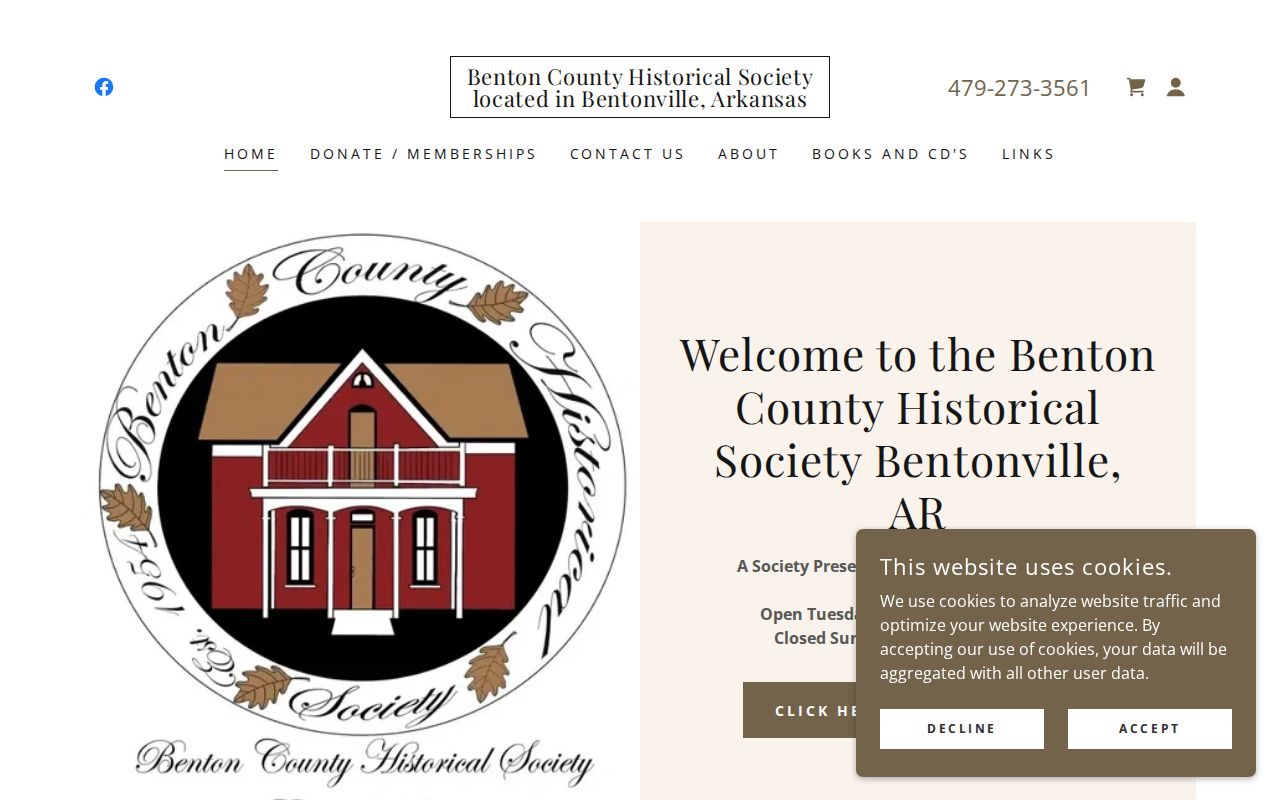
Turn to the society when a Rogers household predates the printed city directory shelf. Try it when a street changed its name. A directory entry may also need a parcel, tax, obituary, or deed cross-check. The county organized in 1836. Not every record series survived in the same form. Early courthouse fires reportedly destroyed some court papers. Hidden deed and circuit records came through intact, which helps explain why historical coverage runs uneven across decades. That patchwork is exactly why the county archive deserves a slow look.
Rogers Directory Occupation Clues
Occupation and firm names can separate residents who share a surname. Rogers began as a Frisco Railway stop. Apple orchards, evaporators, and vinegar works shaped its early trade vocabulary. The Apple Blossom festivals of 1924 through 1927 did the same. Poultry later displaced much of the orchard work. Postwar industry and retail pulled in a larger population. Read any occupation line against the right era. Then check it in museum business files and local newspapers.
The counts tell the story. Rogers held 3,550 residents in 1940 and 4,962 in 1950. Growth accelerated after 1960 and reached 69,908 in 2020. That curve explains why later Northwest Arkansas directories went regional. It also explains why an old Rogers-labeled address may fall outside today's city limits. Printed absences also deserve care. Documented exclusionary practices in the twentieth century shaped who appeared in some sources. So a missing entry should never be read as a statement about a person.
End every good directory match with a full citation. Include the exact title, year, publisher if printed, page, entry text, and repository. Need a modern official record instead? The Rogers resident lookup path can test what the old entry suggests.